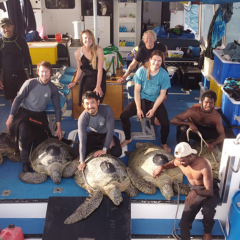
Each time University of Queensland Associate Professor Chris Roelfsema sets foot on the sun-bleached timber jetty of Heron Island, the Dutch national feels like he’s come home.
Understanding how far Great Barrier Reef corals are from their parents could be key to identifying and protecting at risk populations, University of Queensland research has found.
Ahead of this week’s crucial United Nations ocean conference, federal Environment Minister Murray Watt promised that by 2030, 30% of Australian waters would be “highly protected”.
Scientists have launched an interactive global map to show the migratory patterns of more than 100 marine species in an effort to protect at-risk wildlife.
Satellites orbiting Earth offer great potential to better understand the world’s reefs over time beyond the sites visited by researchers, The University of Queensland research has found.
Rather than hiding from predators, the brightest and most patterned sea slugs are active during the day so their colours shine, a University of Queensland study has found.
In a groundbreaking commitment to the health of Queensland’s iconic Moreton Bay, The Goodman Foundation has generously donated $1 million to support a University of Queensland Healthy Moreton Bay Research Chair.
Researchers have discovered a rare example of ‘great fish parenting’ with a common coral reef species found to actively protect their young by eating parasites.
The International Union for Conservation of Nature (IUCN) has released a report that highlights new knowledge and stresses the urgent need to address overfishing and bycatch in all countries.
Professors Sandie and Bernie Degnan from The University of Queensland have been uncovering the ancient secrets of life, focusing in the last 2 decades on a seemingly simple organism – the sponge.
Coral adaptation to global warming will likely be overwhelmed without rapid reductions in global greenhouse gasses, according to an international team of scientists.
Researchers will map the migratory connectivity of green turtles in the Great Barrier Reef (GBR) to boost conservation efforts for the endangered species.
University of Queensland research has revealed that informing tourists visiting the Great Barrier Reef about climate impact doesn’t negatively affect their experience and can help encourage climate action.
The Great Barrier Reef will continue to deteriorate, largely due to climate change, and the window to secure its future is rapidly closing. That is the sobering conclusion of a major new report into the state of the reef.
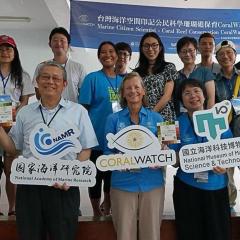
Taiwanese diving instructors, marine affairs postgraduates, reef conservation enthusiasts, artists and even an actress attended CoralWatch’s first international workshop since its inception in 2002.